Britishtheatre.com, 6th November 2015, Stephen Collins
It’s Winter. Christmas. The Royal palace is a warm and friendly place, filled with
love and indulgence, carollers making merry music and the eager Prince keen for just
one present from the tree. The King’s best friend is visiting, his heavily pregnant
wife is radiant with motherhood. It could scarcely be happier.
It starts with a glance. Then a longer look. Then a stare. Along with the carols
comes Jealousy. You can almost see it infecting the King, crippling his mind, his
reason, subverting his passions, creating an unfounded tyrannical rage. It’s frightening
to watch the change - Mr Hyde is an amateur compared to this transformation.
Later, after the Prince is dead and cold, the Queen has been wrongfully imprisoned
and the newborn Princess has been sent to her exiled doom, the old, faithful woman
confronts the King. He is ailing, mourning his lost Prince, nearly unhinged with
the capricious madness that has claimed his regal soul. She spares him not. She lacerates
him for his tyrannical rages, lists his losses and victims, every word a knife in
his heart. Then she floors him - the Queen is dead. Unwavering, she lets his howls
of despair shatter the moonlight.
If there is a dry eye in the house, it belongs to a corpse.
This is Kenneth Branagh and Rob Ashford’s revelatory, unforgettable and game changing
revival of The Winter’s Tale, now playing at the Garrick Theatre. Forget the Cumberbatch
Hamlet. Forget the Nunn War of the Roses. Forget the RSC’s Tetralogy due soon at
the Barbican. This production of The Winter’s Tale is unquestionably THE Shakespearean
event of the year.
The play is one of the last plays Shakespeare wrote and is often regarded as challenging.
But not here. This production is alive in every way, full of passion and precise
power, and fuelled by voice work the like of which has not been heard recently in
the West End. It feels fresh and invigorating, almost as if it were being seen clearly
for the first time. This is a play which has seen many dire productions, here it
is as powerful as Hamlet.
The story is told with brilliant clarity and intense emotion. These actors, as all
should, find energy in the very words of Shakespeare, and that energy propels graceful,
intriguing and overwhelmingly purposeful performances. It is like a fire crackling
- the words are alive with the music of their purpose.
Christopher Oram’s set is utterly gorgeous: all red and gold for the warm start,
then almost black for Perdita’s abandonment in Bohemia, then, as Act Two begins,
winter snow cascades around a moonlit Judi Dench (delivering the speech assigned
to Time by Shakespeare - an inspired touch!), Then the snow mounds are revealed as
wool and we are amongst the rustics, and then back to the original palace, now bleak
and blisteringly cool white, as the ravages of despair have accumulated over the
years. Oram solves the problem of “Exit, pursued by a bear” simply but brilliantly.
His costumes are equally brilliant, sumptuous, utterly delicious in every way.
The lighting from Neil Austin is breath-taking: subtly he changes mood and indicates
perspective with light. You see Hermione and Polixenes as Leontes sees them, but
also as they actually are; you feel the power of the Oracle at Delphi; the magical
moment when Dench/Time tells of the passage of 16 years is so beautiful as to be
almost painful; and then the introduction of Florizel and Perdita is achieved with
a clever lighting device. But the immaculate beauty of the statue Paulina reveals
to Leontes at the last is Austin’s greatest achievement here, and there are many
more, too numerous to list.
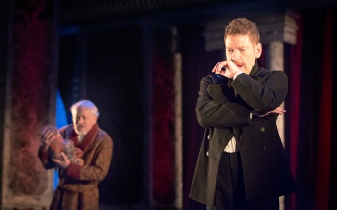
Branagh is in tremendous, unbeatable form as Leontes. He is superb from start to
finish, utterly and totally believable. His transformation from adoring husband and
father to green-eyed monster is incredible detailed, every mis-step clear. When he
finally appears in Act Two, grey of hair and heart, dressed in black, broken by his
sins, he is worthy of sympathy: quite a feat for a man who has unfairly accused his
wife of adultery and thereby caused his son to die of a broken spirit, as well as
exiling his new born daughter to probable death by exposure.
It’s all in the delivery of the verse. Branagh infuses the text with such life that
Leontes is humanised, despite his jealous extremes. Grace, joy, fear, suspicion,
anger, confusion, rage, repentance, regret, hope - no word he speaks does not have
the right ring to it, and his richly drawn Leontes shines.
Miranda Raison is beautiful in absolutely every way as Hermione, grace and spirit
in every move and glance. She makes a perfect match for Branagh, and her trial scene
is brutal and harrowing. Her rapport with Hadley Fraser’s Polixenes is spot on, laying
the ground for Leontes’ nightmarish response. The moment when she finally beholds
her daughter, Perdita, is astonishing, pain and joy in a perfect moment of motherhood.
Fraser makes a terrific Polixenes, and when he turns on his son, it is clear why
he and Leontes were such good friends. Michael Pennington is superb as Antigonus,
a model verse-speaker, and his final moments, before the Bear takes his life, are
extraordinary. John Shrapnel’s Camillo is beautifully judges, expertly spoken, and
provides a strong sense of commitment and duty to monarchs who lose their way.
The scenes in Bohemia can fall flat, but not here. There is a lusty, earthy eroticism
about the place which is entirely ripe and right. Tom Bateman’s very manly Florizel
and Jessie Buckley’s radiant shepherdess Perdita (her opening line brings down the
house) are fantastic together, ardent and joyous. Their love is real, urgent, compelling.
The scene where Fraser’s Polixenes condemns their union is just as impactful, wrong
and stupidly zealous as Branagh’s merciless misjudgement of Hermione.
Jimmy Yuill and Jack Colgrave Hirst are in delicious sync as Shepherd and Clown;
very funny, very human. When the Shepherd is condemned to death by Polixenes, it
is a gripping and frankly horrifying moment, which both play perfectly. They have
great rapport, too, with John Dagleish’s spirited and winning Autolycus, as nimble
and humorous a rogue as Shakespeare wrote.
Later in the play, there is a somewhat awkward scene when the key events happen offstage
but are described onstage. But there is nothing awkward here, indeed, Adam Garcia
is brilliant on this scene and it is difficult to resist tears at the tale he tells.
Stuart Neal, Jaygann Ayeh and Michael Rouse are all exceptionally good in an ensemble
which never puts a foot wrong.
But,without question, the evening belongs to Dench.
The history books record Peggy Ashcroft playing Paulina for the Royal Shakespeare
Company in 1960 in a way which revolutionised the way people thought of the role.
Dench certainly revolutionises Paulina for me here - I have never seen a production
of The Winter’s Tale where Paulina was the central, motivating force of humanity
and goodness. But Dench makes her so.
From the very first moment of this production, when she appears from behind a curtain
with an excited Mamillius and shepherds him to the Christmas tree, Dench brings an
intensity, an energy, a pulse to the production which belies here 80 odd years. She
is more nimble and more forceful than many of those half her age and everything she
does and says adds value, meaning and pleasure to the evening.
Her verse speaking is unrivalled. She picks each word and gives it full, accurate
weight, landing the sense, purpose and exact emotion of every glittering phrase.
She is wily, wise and wonderful. Her pained berating of Leontes when she tells him
Hermione is dead is one of the greatest moments in theatre I have ever seen. So powerful
it knocks breath from your body.
Her speech as Time is unspeakably beautiful, a musing that insinuates itself into
your soul. Her face while Hermione is on trial, where Paulina says nothing, is alive
with expression, fearfully sad yet holding on to hope. When Dench unveils the statue,
it is magical, so perfectly has she set up the moment, planted the seed of what is
to come, been a prism of redemptive possibility. The happiest moment of the play
is also hers, when Leontes marries her to Camillo, perhaps the first good thing he
has done in 16 years.
Dench is transcendent, a force of nature the like of which we may never see again.
To see and hear her in this production is a privilege as much as a pleasure.
The only regret the evening provides is the stark realisation that audiences do not
hear Shakespeare spoken properly, as it is here, very often these days. Would that
it were otherwise. Hopefully, the National Theatre, the RSC and directors everywhere
see this production and learn from it. Craft is critical.
This is pure theatrical magic. The Winter’s Tale for our times, it is mostly sold
out, but it should - nay, must - be seen by anyone who is curious about acting, theatre
or Shakespeare: it’s a masterclass in absolutely every way.